

 Emily Flores
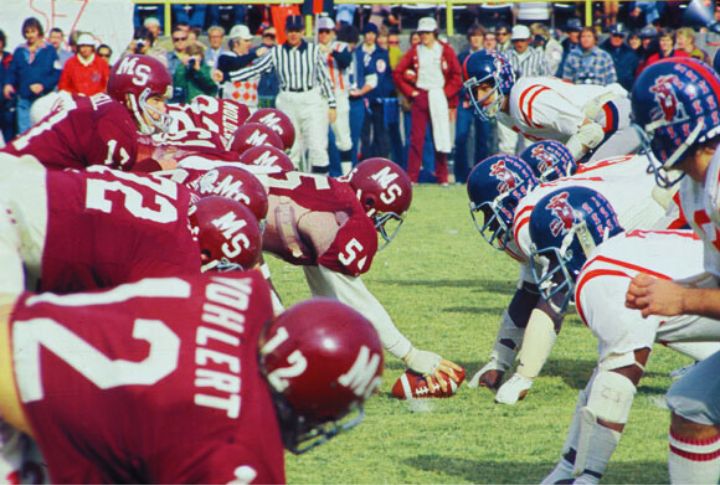
It’s 1926, and fans are literally beating each other with wooden chairs over a football game. Welcome to Mississippi, where college football isn’t just a sport—it’s a blood feud wrapped in school colors. The Ole Miss versus Mississippi State rivalry has been called many things over the years, but “the Egg Bowl” might be the strangest nickname in all of college sports.
And like most great Southern stories, this one involves violence, whiskey, and a golden trophy shaped like a football that people mistook for an egg.
When Goalposts Became Weapons
The chaos began on a fateful day in 1926 when Ole Miss traveled to Starkville and squeaked out a 7–6 victory against Mississippi A&M, as State was known back then. Ole Miss had just snapped a brutal 13-game losing streak, and their fans were ready to celebrate. So naturally, they did what any reasonable college football fans would do—they stormed the field and tried to tear down the goalposts.
Here’s where things went sideways. Mississippi State fans had apparently made a pact to protect those goalposts at all costs. When they saw the Rebels fans coming, they grabbed the nearest weapons they could find: old-fashioned wooden folding chairs. What followed was an all-out brawl that made headlines across the state. Fans were smashing chairs over each other’s heads, and the scene became so chaotic that officials realized something had to change. You couldn’t just have people hospitalizing each other over a football game every single year, could you?
The Birth Of The Golden Egg
In response to the mayhem, students from both universities came together in 1927 to create a solution. They designed a trophy—a regulation-size, gold-plated football mounted on a wooden base. The Iota Sigma honorary activities fraternity at Ole Miss handled the design. The idea was simple: give fans something shiny to focus on instead of violence. Present the trophy to the winning team immediately after the game, creating a ceremonial moment that would distract everyone from thoughts of chair-throwing and goalpost destruction.
The trophy’s oval shape earned it the nickname “The Golden Egg,” and the rivalry game became known as the Battle for the Golden Egg. It worked, mostly. The trophy gave the rivalry a focal point and transformed postgame celebrations from mob violence into an actual tradition. Since 1927, the winning team has taken home that gleaming golden football, and the series has been played continuously every year since 1944—making it one of the longest uninterrupted rivalries in college football history.
Golden Egg To Egg Bowl
But here’s the twist: the game wasn’t actually called the “Egg Bowl” until 1978. For over fifty years, everyone called it the Battle for the Golden Egg. Then came a season when both teams were mediocre—Mississippi State was 6–4, Ole Miss was 4–6, and neither school was going bowling. The Mississippi newspaper, the Clarion Ledger, saw an opportunity for a clever headline. Since this would be each team’s final game and their only “bowl” of the season, a writer coined the term “Egg Bowl” for the matchup.
Ole Miss won that game 27–7, and the nickname stuck like Mississippi humidity. The media kept using it, fans embraced it, and within a few years, “Egg Bowl” became the official moniker for one of college football’s wildest rivalries.