

 Emily Flores

Holiday traditions look innocent at first glance, yet many have tangled histories tucked behind the glitter. Some symbols sparked arguments, others raised suspicions, and a few even survived bans. So before you hang another ornament, take a look at the stories that kept these traditions far spicier than they appear.
Christmas Tree
The Christmas tree started in ancient winter customs that used evergreens to show life in the cold season. Christians later adopted the idea and gave it spiritual meaning. When the practice reached early America, Puritans pushed back and saw it as wasteful. In Alsace, families were even limited to cutting tiny trees to protect woodlands.
Santa Claus
You probably know Santa Claus as the jolly gift-giver at Christmas, but he actually comes from Saint Nicholas, a generous bishop from the 4th century. Over time, his story mixed with old pagan traditions and 19th-century tales. Some Christians even worry that he distracts from the real meaning of Christmas, though bans in early America are mostly myths.
Mistletoe
Mistletoe’s origins tie to pagan fertility rituals, causing historical controversy among Christian churches, some of which banned it from services. In addition, the tradition of kissing under mistletoe started in 18th-century England. Interestingly, the plant is parasitic, which grows on trees and shrubs, thereby giving this festive custom a curious biological twist.
Yule Log
Originally, the Yule log was part of pagan winter solstice celebrations. Some Christian leaders tried to discourage it because of its pagan ties. Today, people enjoy it as a chocolate dessert shaped like a log, sometimes called a “Yule log cake,” while old traditions believed that burning the log could bring protection and keep evil spirits away.
Nativity Scene
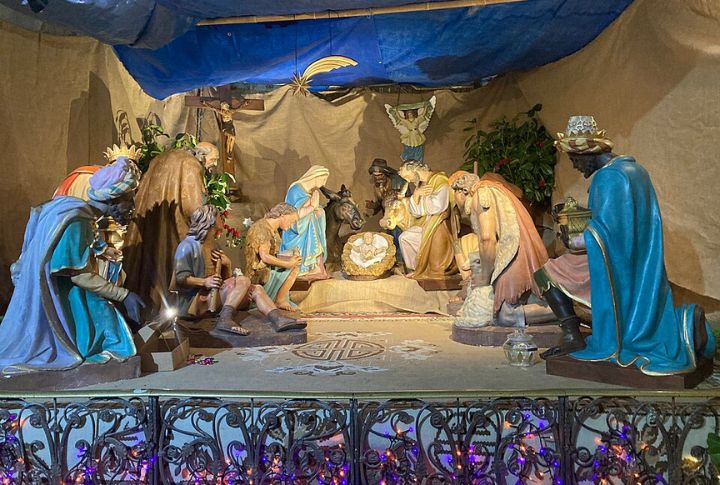
Nativity scenes depict Jesus’ birth, a core part of Christian tradition. Yet showing them publicly can stir controversy, particularly in the U.S., where separation of church and state is key. While cherished by believers, public displays often prompt debates about fairness and government endorsement of a specific faith.
Candy Canes
The iconic red-and-white candy canes trace their roots to folklore rather than verified history. Their shepherd-crook shape is often tied to Christian symbolism, which led some schools and public spaces to ban them. Over time, plain sugar sticks were transformed into a classic holiday treat with peppermint flavoring.
Christmas Wreaths
Modern Christmas wreaths evolved from pre-Christmas wreaths, used in Christian tradition to mark the Sundays leading up to Christmas. Contrary to popular claims, there is little evidence linking them to the pagan festival Saturnalia or causing controversy. Their circular evergreen shape symbolizes eternity, highlighting Christian roots and making them both decorative and meaningful.
Christmas Lights
Christmas lights started with candles placed on trees, a tradition rooted in Christianity. Today, elaborate light displays sometimes face criticism for safety risks or over-commercialization. Electric lights first appeared in the late 1800s; however, debates continue over energy use and whether flashy decorations detract from the holiday’s spiritual meaning.
Christmas Angels
You’ll see angels everywhere at Christmas, especially on top of trees, but the funny thing is their modern look actually came from the Victorian era—the period in the 1800s when Queen Victoria ruled Britain—not from the Bible. That’s why some Christians feel they’ve become too commercial. Still, most people use them simply because they look peaceful and festive.
Christmas Elves
Christmas elves, depicted as Santa’s toy-making helpers, emerged from European folklore and 19th-century literature. While they have no pagan roots, their popularity has become controversial in some circles due to commercialization. Their playful, whimsical image contrasts with earlier folklore, where elves were sometimes feared, showing how tradition can evolve into festive storytelling over centuries.